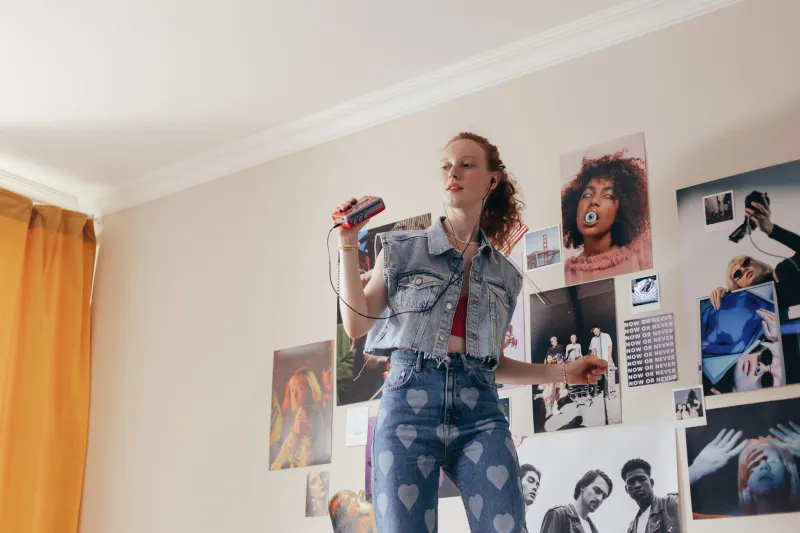
You Don't Sing What You Stream: The Secret Playlist Living Inside Your Head

Be honest. You have a shower playlist that will never see the light of day.
Maybe it's a power ballad you'd never admit to loving. Maybe it's a Disney soundtrack. Maybe it's a Celine Dion deep cut that you perform with the full theatrical commitment of someone who has absolutely nothing to lose. Whatever it is, there's almost certainly a gap between the music you consciously log, share, and identify with — and the music that takes over your body when no one's watching.
At JukeLog, we've noticed this pattern in how users describe their listening habits. People will log thoughtful, eclectic libraries full of indie artists, overlooked jazz records, and carefully curated playlists — and then in the same breath mention that they've been screaming "Bohemian Rhapsody" in their car every single day for three weeks. The logged taste and the performed taste don't always match up.
That's not a bug. It's one of the most interesting things about how music actually functions in our lives.
The Performance Playlist Is a Different Animal
When we talk about music we love, we usually mean music that moves us emotionally, music that feels authentic to who we are, music we want to share. But the songs that make us want to perform — to sing, dance, air guitar, or dramatically lip-sync into a hairbrush — are responding to a completely different set of triggers.
Performance songs tend to share a few key qualities. They're usually highly familiar — you know every word, every key change, every breath before the chorus drops. They often have a big dynamic range, building toward a moment that feels almost physically satisfying to hit. And they tend to carry a specific kind of emotional energy: cathartic, triumphant, or just gloriously over the top.
Think about it. Nobody sings along to ambient music. Nobody air-drums to a lo-fi study playlist. The songs that take over your body are almost always the ones engineered — intentionally or not — to invite participation.
What JukeLog Users Are Actually Doing When No One's Looking
We asked our community to share the songs they perform most passionately in private versus what they actually log and recommend. The results were predictably chaotic and completely wonderful.
Derek S., 27, from Nashville, logs primarily underground hip-hop and experimental production. His private performance playlist? "Anything by Journey. I'm not proud of it but I'm not ashamed of it either. 'Don't Stop Believin'' gets a full stadium performance from me every time."
Anika R., 31, from Seattle, keeps a carefully curated indie folk library on her JukeLog profile. "But when I'm driving alone? Full Beyoncé. Full choreography at red lights. I'm not logging that."
Then there's Tom V., 45, from Philadelphia, who logs mostly classic rock and blues. "My daughter got me into Taylor Swift and now I know every single word to 'All Too Well (Ten Minute Version).' I have performed that song in my kitchen more times than I can count. I will never put it on my profile."
The pattern holds across age groups, genres, and musical backgrounds. The songs we perform in private occupy a totally separate psychological category from the songs we curate and share.
Why Certain Songs Hijack Your Body
Musicologist and performer Nina Kraus has written extensively about the body's physical response to music — the way rhythm and melody can literally synchronize with our motor systems. When a song has a strong enough groove or a compelling enough build, your body doesn't wait for permission. It just responds.
But beyond the physical mechanics, there's an emotional release component that therapists find genuinely significant. Licensed music therapist Jordan Falk explains it this way: "Singing, especially singing loudly and alone, is one of the most accessible forms of emotional release we have. You're not performing for judgment. You're not being evaluated. You get to feel the full force of the song without any social risk."
That social risk piece is key. The songs we log and share on platforms like JukeLog are, at least partly, a form of self-presentation. They signal taste, identity, and belonging. The songs we perform alone carry none of that weight. They're purely functional — and that freedom is exactly what makes them so satisfying.
The Taste Gap Is Telling
Here's the thing that makes this phenomenon genuinely worth thinking about: the gap between your logged taste and your performance taste isn't random. It usually maps onto something real about your inner life.
The songs people perform most intensely in private tend to be the ones that hit an emotional register they don't always let themselves access publicly. The person who logs cool, understated indie music but screams power ballads alone might be someone who keeps their emotional volume carefully controlled in social settings. The private performance is where they let it out.
Conversely, some people log emotionally raw, vulnerable music — the kind of stuff that makes you cry in public — but their private performance playlist is pure banger. For them, the performance space is where they get to be big and loud and unserious in a way their curated identity doesn't always allow.
Neither direction is better. Both are useful windows into what you actually need from music on any given day.
Closing the Gap (Or Not)
So should you start logging your bathroom performances? Maybe.
There's something genuinely freeing about being honest with your JukeLog library — adding the guilty pleasure alongside the critically acclaimed, logging the song you performed at full volume on the highway next to the quiet track you listened to thoughtfully with headphones. The contrast is part of the picture.
But there's also something worth protecting about the private performance. Not everything needs to be logged, shared, or explained. Some songs exist just for you — for the version of you that doesn't have an audience, doesn't have a profile, doesn't need to justify what they love or why.
That version of you has excellent taste. Even if it never makes the playlist.